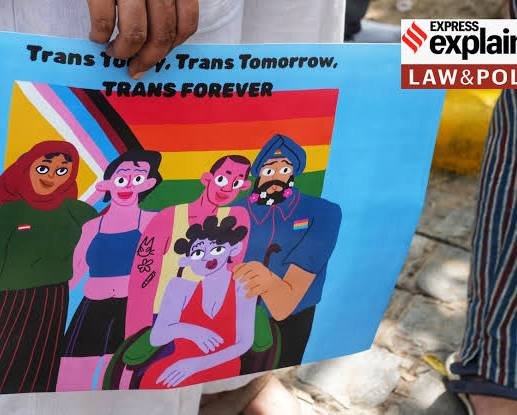
Plea in Supreme Court challenges Transgender Act provision on changing legal gender
The India chapter of Women's Declaration International (WDI) has filed a plea in the Supreme Court challenging Section 7 of the Transgender Persons (Protection of Rights) Act, 2019 and Rule 7 of the Transgender Rules. These allow a person to get official documents recognising a gender different from the one assigned at birth. The petitioner argues this could affect protections meant for women.
Why in news
Background: WDI is a UK-based group that campaigns to keep sex-based protections for women. The plea also seeks a reconsideration of the NALSA (2014) judgment, which recognised a transgender person's right to determine their own gender identity. Senior Advocate Jayna Kothari told the Indian Express that the plea tries to reopen a question the Court has already settled.
Prelims pointers
- In NALSA v. Union of India (2014), the Supreme Court distinguished biological sex from gender identity and held that a person's own understanding of their gender should be given primacy.
- NALSA held that discrimination on the ground of "sex" under Articles 15 and 16 includes discrimination based on gender identity, and located the right in Article 21 (dignity and personal liberty).
- NALSA also held that no one can be forced to undergo surgery, sterilisation or hormone therapy to get legal recognition of their gender.
- Under the 2019 Act, a transgender person can get a certificate of identity from the District Magistrate. Section 7 allows a revised certificate after gender-affirming surgery.
- NALSA recognised transgender persons as a "third gender" and directed reservations as socially and educationally backward classes.
- In Navtej Singh Johar v. Union of India (2018), the Supreme Court decriminalised consensual same-sex relations by reading down Section 377 of the IPC.
Mains angle
The plea reflects a wider global debate between gender identity rights and sex-based protections for women, for example in sports, shelters and reservations. In India, the NALSA judgment and the 2019 Act lean towards self-identification, though the Act's surgery requirement under Section 7 has itself been criticised for going against NALSA. Any reconsideration will need to balance dignity, equality and the specific protections that women need.