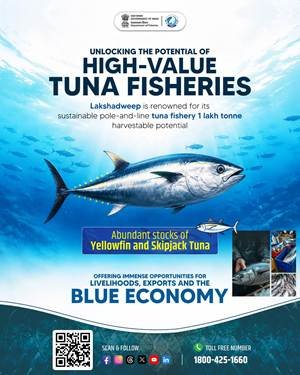
Island fisheries at the centre of India’s blue economy push in Lakshadweep and Andaman and Nicobar
The Ministry of Fisheries, Animal Husbandry and Dairying has said Lakshadweep and the Andaman and Nicobar Islands will anchor growth in tuna, seaweed and ornamental fisheries as part of India's blue economy campaign.
Why in news
Background: The two island groups together account for about 40% of India's Exclusive Economic Zone (EEZ). Tuna stocks such as yellowfin, skipjack and bigeye in the surrounding waters are considerably underused. Lakshadweep's five-year plan aims to double tuna production to 50,000 tonnes.
Prelims pointers
- India has a coastline of about 11,099 km and an EEZ of about 24 lakh sq km, according to the ministry.
- Estimated marine fisheries potential is 58.6 lakh tonnes, supporting about 50 lakh fishers.
- Seafood exports were worth about ₹73,890 crore in 2025-26.
- Since 2015, the Government has committed ₹39,272 crore to the fisheries sector.
- PMMSY allocations: ₹218 crore for the Andaman and Nicobar Islands and ₹175 crore for Lakshadweep.
- Lakshadweep has been notified as a dedicated seaweed cluster. It also hosts more than 300 reef-associated ornamental fish species.
- The Pradhan Mantri Matsya Sampada Yojana (PMMSY) was launched in 2020 to develop the fisheries sector.
Mains angle
Island territories offer large, underused marine resources and strategic depth in the Indian Ocean. Developing tuna, seaweed and ornamental fisheries can raise local incomes and exports. The challenge is to do so sustainably, given fragile coral ecosystems, limited infrastructure and the risk of overfishing.