 UnderStand UPSCUPSC Live · 60 words
🔥0
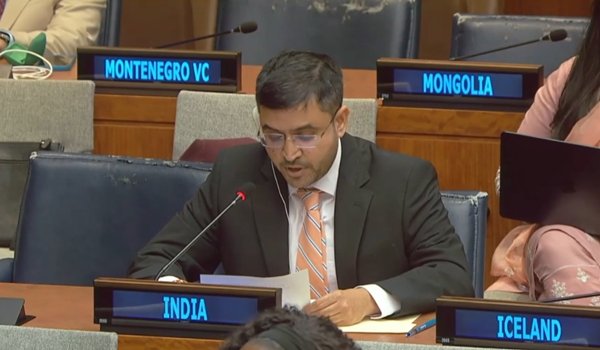
India slams Pakistan at the UN, calls the military its “real ruler”
On 24 October, India hit back at Pakistan in the UN General Assembly's Third Committee during a dialogue with the Special Rapporteur on Minority Issues. Raghoo Puri, First Secretary at India's Permanent Mission to the UN, accused Islamabad of painting a "propagandist" picture of India. He said Pakistan's "Form 47 government" dare not override instructions from the military, which he called the country's real rulers.
Why in news
What "Form 47" means: Form 47 is the Pakistani election document that records provisional consolidated results of a constituency. Pakistan's February 2024 general election faced allegations of rigging, and critics use "Form 47" as shorthand for a government of doubtful mandate. India's use of the term signals sharper public messaging on Pakistan's civil–military imbalance. The SAARC angle: India also placed the blame for SAARC's paralysis on Pakistan. The 2016 SAARC summit in Islamabad was called off after India pulled out over cross-border terrorism following the Uri attack. India has since focused on BIMSTEC and other groupings that do not include Pakistan. Other points India made: Pakistan was using the UN to divert attention from its economic distress, lawlessness and human rights violations at home. Pakistan's minority population has been shrinking, and it should look after its own citizens. Jammu and Kashmir is an integral part of India. The only outstanding issue is Pakistan vacating the territory it illegally occupies. India is a multi-religious, multi-ethnic and multilingual society with constitutional safeguards for minorities. Protecting minority rights is mainly the sovereign responsibility of each country.
Prelims pointers
- The UNGA has six Main Committees. The Third Committee handles social, humanitarian and cultural issues, including human rights.
- First = Disarmament and International Security. Fourth = Special Political and Decolonisation. Sixth = Legal.
- Special Rapporteurs are independent experts appointed by the UN Human Rights Council (Geneva, created 2006).
- SAARC was set up in Dhaka in 1985. Its secretariat is in Kathmandu and it has eight members. The last summit was held in Kathmandu in 2014.
- BIMSTEC was formed in 1997 and has seven members. Its secretariat is in Dhaka.
Mains angle
India now uses multilateral forums to question Pakistan's democratic credentials directly, not just its record on terrorism. This strengthens the narrative of isolating Pakistan, but it also turns thematic UN human-rights dialogues into bilateral battlegrounds. India's regional strategy rests on: Terrorism as the core obstacle to normal ties. BIMSTEC and sub-regional (BBIN) cooperation as alternatives to SAARC. Neighbourhood First outreach to smaller South Asian states.
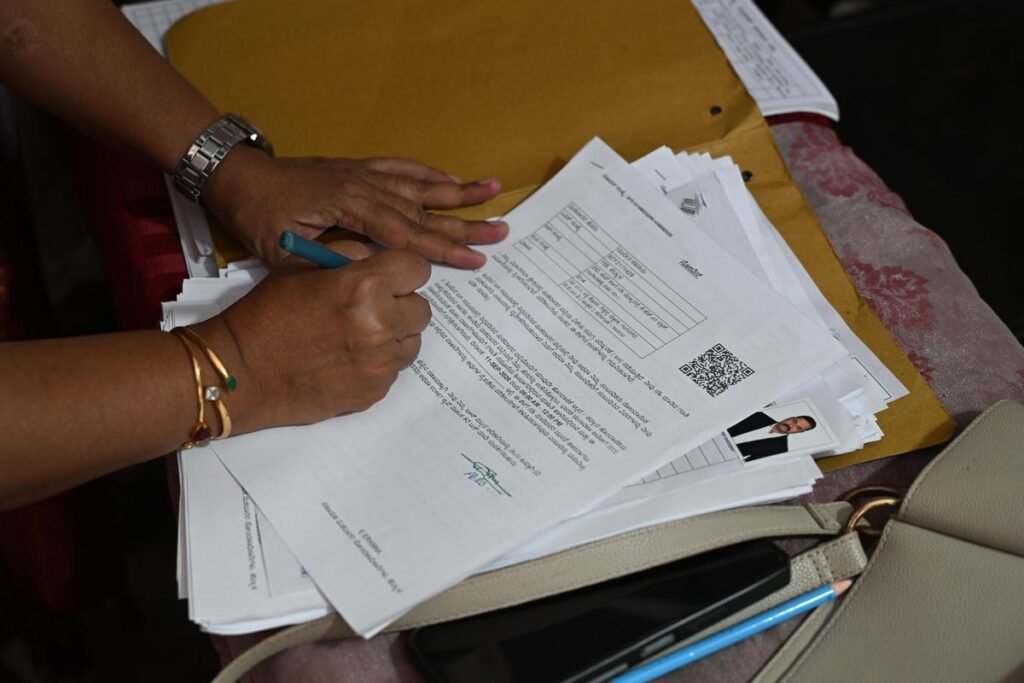
Karnataka SIR: poll officials filed 61,000 Form 7 applications, none citing a reason
The Hindu reported on 26 October that about 61,000 Form 7 applications in Karnataka, roughly one-third of all such forms in the State, were filed by poll officials themselves. None of them records a reason for deletion. The finding comes amid the Special Intensive Revision (SIR) of electoral rolls and an ongoing row over bulk Form 7 filings.
Why in news
What Form 7 is: It is the form used to object to the inclusion of a name or seek its deletion from the electoral roll. Valid grounds include death, shifting of residence, duplicate entry and not being a citizen. A form without a stated reason gives the voter nothing specific to answer at the hearing. Background of the row: Karnataka's SIR began on 16 June 2026. The State CEO's office reported 91,278 Form 7 applications by 4 October. Bulk filings in some constituencies led to several FIRs, a dharna by Chief Minister D.K. Shivakumar and counter-charges by the BJP. The CEO has said no voter has been deleted merely because a Form 7 was filed. A party's Booth Level Agent (BLA-2) may file only up to 10 Form 7s at a time and 50 during the whole SIR.
Prelims pointers
- Form 6 = new enrolment. Form 6A = overseas (NRI) electors. Form 7 = objection or deletion. Form 8 = correction, shifting or replacement EPIC.
- Section 22 of the Representation of the People Act, 1950 deals with correction of entries in electoral rolls.
- Section 31 of the RP Act, 1950 punishes false declarations in connection with rolls with imprisonment up to one year, or fine, or both.
- Booth Level Officers (BLOs) are government officials. Booth Level Agents (BLAs) are appointed by political parties.
- In ADR v. Union of India (May 2026), the Supreme Court upheld the Bihar SIR and stressed notice, inquiry, hearing and a reasoned order before deletion (Rule 21A, Registration of Electors Rules, 1960).
Mains angle
Deletion is the most sensitive part of roll revision, because a wrong deletion silently takes away the right to vote. When officials file objections without reasons, the burden shifts unfairly to voters. Safeguards needed: A recorded reason and evidence on every Form 7. Public, booth-wise lists of proposed deletions. Personal notice and hearing before any deletion. Action under Section 31 against false or bulk objections.
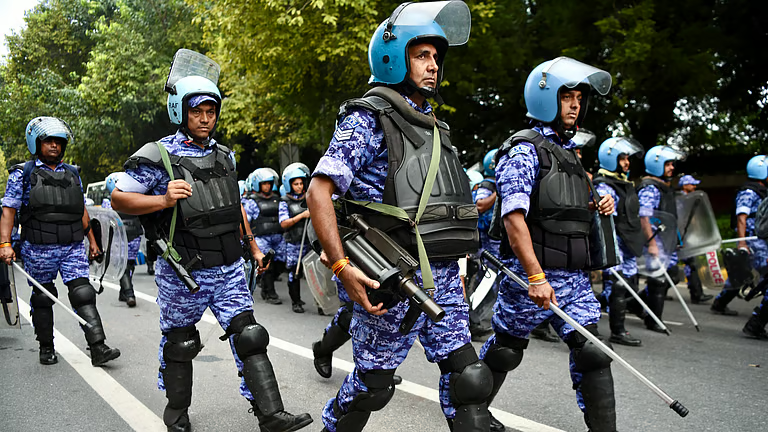
RAF rushed to Arunachal Pradesh amid protests against the Siang Upper Multipurpose Project
The Ministry of Home Affairs said on 24 October that two Rapid Action Force (RAF) companies of the CRPF, about 250 personnel, would be airlifted from Navi Mumbai to Pasighat on an IAF aircraft. Violence broke out in Pasighat after a 12-hour bandh in Siang, Upper Siang and East Siang districts against the proposed 11,200-MW Siang Upper Multipurpose Project (SUMP). The bandh itself had been peaceful.
Why in news
About the project: Proposed on the Siang river by NHPC, it would be among India's largest hydropower projects. The Arunachal government says it would have about 9.2 billion cubic metres of live storage. The State calls it a national project with strategic and security value, not just a power project. A pre-feasibility report is to be prepared first. Social and environmental impact assessments and a DPR would follow if it is found feasible. The China factor: China is building a mega dam (about 60,000 MW) on the Yarlung Tsangpo upstream. India argues a large reservoir on the Siang could absorb sudden water releases and reduce flood risk in Arunachal and Assam. Why locals oppose it: Fear of displacement and loss of farmland, forests and villages of the Adi community. Ecological damage in a seismically active zone. Complaints that consent is being forced through security deployment.
Prelims pointers
- The Brahmaputra rises near Mansarovar in Tibet as the Yarlung Tsangpo. It enters Arunachal Pradesh as the Siang (Dihang).
- Near Sadiya in Assam, the Siang is joined by the Dibang and the Lohit, and the river is called the Brahmaputra.
- In Bangladesh it is called the Jamuna.
- The RAF is a specialised riot-control wing of the CRPF, raised in 1992.
- The Forest Rights Act, 2006 gives Gram Sabhas a role in decisions on diverting forest land.
- India and China share hydrological data on trans-border rivers through an Expert Level Mechanism set up in 2006.
Mains angle
The SUMP sits at the meeting point of energy security, water security and border strategy. But large dams in tribal areas succeed only with real consent. A balanced approach needs: Free, prior and informed consultation with Adi communities. Independent social and environmental impact studies. Fair compensation and livelihood plans. Dialogue first, with security deployment as a last resort.
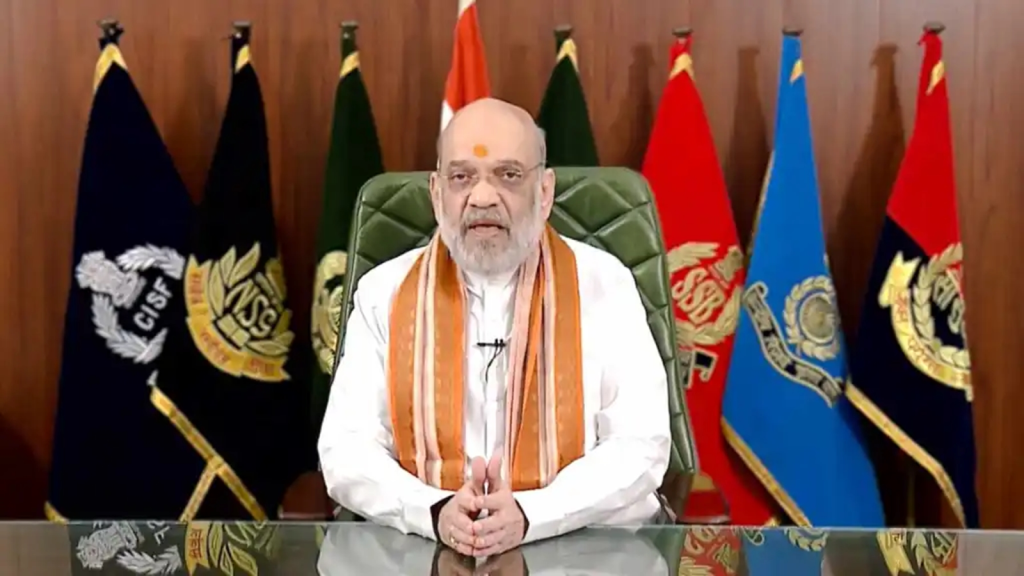
PM inaugurates RBI data centre and Cybersecurity Training Institute in Bhubaneswar
On 25 October, Prime Minister Narendra Modi inaugurated the Reserve Bank of India's ₹169-crore data centre and Cybersecurity Training Institute in Bhubaneswar, Odisha. He said wars are no longer fought only with weapons and that a country can be weakened by attacks on its economy. Protecting the banking system from cybercriminals and cyberterrorists is therefore a national priority.
Why in news
What the PM said: Cyber threats are changing, and outdated systems, old training methods and obsolete tools cannot meet them. India needs both modern infrastructure and a skilled cyber workforce, which the new institute is meant to build. Odisha is moving from a mineral-based economy towards micro-chip manufacturing. Why banks are a target: Digital payments (UPI, cards, net banking) mean money now moves through networks that can be attacked. A successful attack can freeze payments, leak customer data and shake trust in the financial system. Training people is as important as hardware, because many breaches start with human error such as phishing.
Prelims pointers
- CERT-In is the national nodal agency for cyber incident response under Section 70B of the IT Act, 2000. It works under MeitY.
- The National Critical Information Infrastructure Protection Centre (NCIIPC) is set up under Section 70A of the IT Act. It works under the National Technical Research Organisation (NTRO).
- The Indian Cyber Crime Coordination Centre (I4C) works under the Ministry of Home Affairs. Citizens report cyber fraud on helpline 1930.
- The National Cyber Security Policy was released in 2013.
- Reserve Bank Information Technology Pvt. Ltd. (ReBIT) is a wholly owned RBI subsidiary for IT and cybersecurity.
- The Digital Personal Data Protection Act, 2023 governs how organisations, including banks, handle personal data.
Mains angle
Financial cyber resilience is now part of national security. Gaps include a shortage of trained cyber professionals, legacy IT in smaller banks and cooperative banks, and dependence on foreign hardware and software. Priorities: A dedicated cyber workforce pipeline for the financial sector. Regular audits and stress tests of bank IT systems. Real-time information sharing between RBI, CERT-In and banks. Customer awareness against digital-arrest and phishing frauds.
Operation Trident: 18 held, ₹100 crore hawala traced in Northeast drug raids
The Union Home Ministry said on 25 October that "Operation Trident" busted a narco-hawala network running drugs from Myanmar into the Northeast. The Narcotics Control Bureau (NCB) led raids at 38 locations in Assam, Mizoram and Manipur with State police and the Enforcement Directorate (ED). Eighteen people were arrested and about ₹100 crore of hawala transactions were detected.
Why in news
What was seized: 1,424 bank accounts frozen. Assets worth about ₹17.82 crore attached. 500 detonators and ₹12 lakh cash seized. Where the raids took place: Mizoram: Aizawl, Champhai and Zokhawthar (a border town facing Myanmar). Manipur: Churachandpur. Assam: the Cachar transit corridor. How the money moved: Myanmar-based organisers hired local carriers to move drugs across the India–Myanmar–Bangladesh border belt, which the ED called the "Death Triangle Corridor". Drug cash was pushed into banks through mini-ATM and customer service point (CSP) counters. One counter, code-named "Nuniang", made 2,947 transfers worth ₹175.03 crore between 2024 and June 2026. Home Minister Amit Shah set a target of ending every drug network by 31 December 2029.
Prelims pointers
- The NCB was set up in 1986 under the NDPS Act, 1985 and works under the Ministry of Home Affairs.
- The ED enforces the Prevention of Money Laundering Act (PMLA), 2002 and FEMA, 1999. It works under the Department of Revenue, Ministry of Finance.
- Golden Triangle = Myanmar, Laos and Thailand (opium/heroin, methamphetamine). Golden Crescent = Afghanistan, Iran and Pakistan.
- India shares a 1,643 km border with Myanmar, touching Arunachal Pradesh, Nagaland, Manipur and Mizoram.
- Hawala is an informal money-transfer system that moves value without moving money through banks.
Mains angle
The case shows that following the money hurts cartels more than seizing a consignment. It also exposes a weak point in financial inclusion: agent-banking counters built for the poor can be misused for laundering. Lasting results need: Tighter anti-money-laundering checks at mini-ATM and CSP points. Border fencing and intelligence-sharing with Myanmar. Coordination among NCB, ED, Assam Rifles and State police. De-addiction and rehabilitation in border districts.
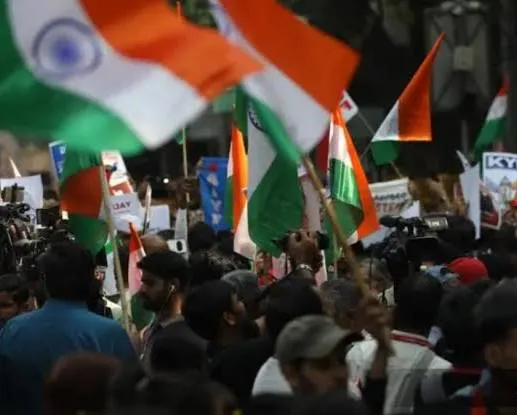
Protests in Delhi against the Special Intensive Revision and the CEC
On 23 October, civil society groups, students and farmers' organisations marched towards the Election Commission of India (ECI) headquarters in New Delhi. They protested against the Special Intensive Revision (SIR) of electoral rolls and Chief Election Commissioner Gyanesh Kumar. Police detained more than 100 protesters.
Why in news
Key Points: Demands of the protesters: Resignation of CEC Gyanesh Kumar. Withdrawal of the SIR. Repeal of the 2023 law on appointing Election Commissioners. Restoration of Jantar Mantar as a protest site. About the SIR: It is an intensive exercise to verify and update electoral rolls. It aims to remove duplicate, dead and shifted voters while including all eligible voters. Critics point to wrongful deletions, heavy document requirements and weak procedural safeguards.
Prelims pointers
- Article 324 vests the superintendence, direction and control of elections, including preparation of electoral rolls, in the ECI.
- Article 326 provides for elections to the Lok Sabha and State Assemblies on the basis of adult suffrage.
- Section 21 of the Representation of the People Act, 1950 governs preparation and revision of rolls. Section 21(3) allows the ECI to order a special revision.
- The CEC and Other ECs (Appointment, Conditions of Service and Term of Office) Act, 2023 sets up a selection committee:
- the Prime Minister (chair),
- the Leader of the Opposition in the Lok Sabha,
- a Union Cabinet Minister nominated by the PM.
- In Anoop Baranwal v. Union of India (2023), the Supreme Court had set an interim committee of the PM, the LoP and the CJI until Parliament made a law.
- Under Article 324(5), the CEC can be removed only in the manner of a Supreme Court judge. Election Commissioners can be removed only on the CEC's recommendation.
- Section 163 of the BNSS replaces Section 144 of the CrPC. It allows Executive Magistrates to issue urgent orders in cases of nuisance or apprehended danger.
Mains angle
Accurate rolls prevent impersonation and duplicate voting, but wrongful deletions undermine universal adult franchise. The ECI's credibility depends on the safeguards around deletions: Public lists of proposed deletions. Notice and a hearing for affected voters. Accessible claims and appeals. Accountability of Booth Level Officers.
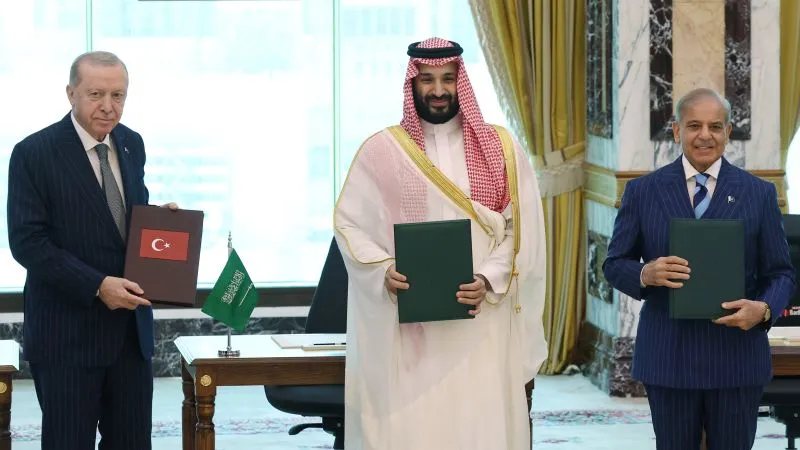
Full text of Pakistan–Saudi–Turkey ‘Mecca’ defence pact released
The full text of the Mecca Joint Defence Agreement between Pakistan, Saudi Arabia and Turkey is out. It became public after Turkey submitted the agreement to its Parliament for ratification on 20 October. The 16-article pact focuses more on military capacity-building than on NATO-style mutual defence.
Why in news
The pact was signed over two months ago. It builds on the Saudi–Pakistan defence agreement and reflects new security arrangements in West Asia as US protection shrinks. On 21 October, Qatar, Pakistan, Turkey and Indonesia signed a separate military cooperation agreement.
Prelims pointers
- Article 2 treats an armed attack on one party as requiring others to assist with "all means" they can provide. It does not bind them to use force, unlike NATO's Article 5.
- Seven articles deal with joint capacity-building: security consultations, counter-terrorism, joint training and exercises, intelligence sharing and logistics.
- Article 7 commits the parties to defence-technology sharing, joint development and joint production.
- Pakistan, Saudi Arabia and Turkey are named as "core parties" for 10 years, leaving room for new members.
- Comparable treaties:
- North Atlantic Treaty (NATO), 1949.
- Collective Security Treaty (CSTO), 1992.
- GCC Joint Defence Agreement, 2000.
Mains angle
A Pakistan-linked defence-industrial bloc in West Asia could affect India's ties with Saudi Arabia and the Gulf, its energy security and the welfare of its diaspora there.
Haryana regulator grants first private parallel power distribution licence
The Haryana Electricity Regulatory Commission has granted Eleven Power Pvt Ltd a 25-year parallel distribution licence for Gurugram and Nuh. It will be the first private player in Haryana's power distribution. The Haryana government, which opposed the move, plans to appeal to the Appellate Tribunal for Electricity.
Why in news
Haryana's distribution is run by two state discoms, UHBVN and DHBVN. A parallel licence lets a second company supply power in the same area through its own network, giving consumers a choice of supplier.
Prelims pointers
- The sixth proviso to Section 14 of the Electricity Act, 2003 allows two or more distribution licensees in the same area, each with its own network.
- Eleven Power plans a capital investment of ₹4,717 crore between 2026-27 and 2030-31.
- Mumbai is India's best-known example of overlapping licensees: Tata Power, BEST and Adani Electricity.
- The Appellate Tribunal for Electricity (APTEL) hears appeals against orders of electricity regulatory commissions under the Electricity Act, 2003.
- According to a Central Electricity Authority report, fixed costs make up 38–56% of a discom's annual revenue requirement. Fixed charges recover only about 9–20% of revenue.
- Electricity is a Concurrent List subject (Entry 38).
Mains angle
Competition can improve service. But duplicate networks and loss of high-paying industrial consumers could raise costs and weaken the cross-subsidies that keep household and farm tariffs low.

Google, Mozilla, Apple and Microsoft block eMudhra certificates over key flaw
Major browser companies have blocked certificates linked to Bengaluru-based eMudhra. Eight of its intermediate certificate-authority keys were generated with too little randomness, which made them potentially recoverable by attackers. CERT-In issued an advisory on 21 October.
Why in news
Websites prove their identity through digital certificates issued by certification authorities, in a hierarchy of root, intermediate and end-user certificates. A weak key at an intermediate level could let attackers issue fake certificates, impersonate websites or sign malware.
Prelims pointers
- Of the eight affected certificates, six were for authenticating websites (TLS) and two were for signing software. The flaw was reported to browser companies on 17 October by an independent researcher.
- eMudhra traces the flaw to a key-generation exercise on 30 April 2025. It says only one affected authority was in production, and none had issued end-user certificates.
- Google said no website certificates chaining to the affected authorities appeared in Certificate Transparency logs before it blocked them.
- In India, certifying authorities that issue digital signature certificates are licensed by the Controller of Certifying Authorities (CCA) under the IT Act, 2000. Other licensed authorities include Safescrypt, Capricorn and nCode.
- eMudhra is India's largest certifying authority, with about 38% of the digital signature market by value. It says its Indian digital signature and eSign businesses run on separate infrastructure and were not affected.
Mains angle
Internet security rests on trust in a few certification authorities. One lapse can undermine HTTPS, so key management needs strict audits and fast revocation.
You're all caught up for today!
Now lock it in with practice: