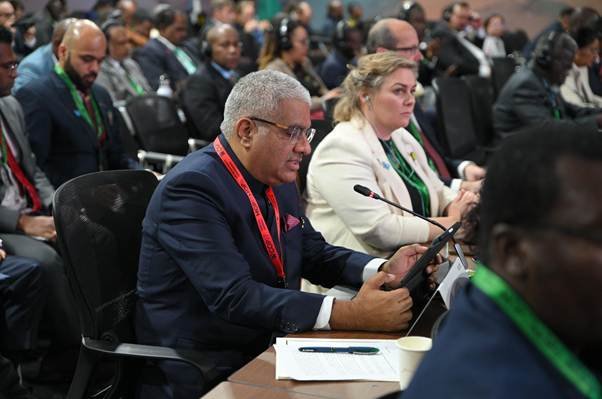
India presents its biodiversity roadmap at CBD COP-17 in Yerevan
At the 17th Conference of the Parties (COP-17) to the Convention on Biological Diversity in Yerevan, Armenia, Union Environment Minister Bhupender Yadav on 27 October set out India's progress under its updated National Biodiversity Strategy and Action Plan (NBSAP). He also backed full operationalisation of the Cali Fund, which channels benefits from the use of Digital Sequence Information (DSI) back to biodiversity-rich countries and communities.
Why in news
COP-17 is the first major review of how countries are implementing the Kunming-Montreal Global Biodiversity Framework (KMGBF), adopted at COP-15 in December 2022. Every party had to update its NBSAP to match the framework's targets.
Prelims pointers
- The CBD was opened for signature at the Rio Earth Summit (1992) and entered into force in December 1993. Its secretariat is in Montreal, Canada.
- The CBD has three objectives: conservation of biodiversity, sustainable use of its components, and fair and equitable sharing of benefits from genetic resources.
- The KMGBF has 4 goals for 2050 and 23 targets for 2030. Target 3, popularly called "30x30", aims to conserve 30% of land and 30% of oceans by 2030.
- India's updated NBSAP mirrors the KMGBF with 23 national targets tracked through 142 indicators.
- The Cali Fund was created at COP-16 in Cali, Colombia (2024). Large companies using DSI are expected to contribute 1% of profits or 0.1% of revenue.
- India's figures cited at COP-17: 1,134 protected areas, 103 Ramsar sites, 57 Biodiversity Heritage Sites and 18 Biosphere Reserves, of which 13 are in UNESCO's Man and the Biosphere (MAB) network.
- Two protocols operate under the CBD: the Cartagena Protocol on Biosafety (2000), on living modified organisms, and the Nagoya Protocol (2010), on access and benefit-sharing.
- India implements the CBD through the Biological Diversity Act, 2002 (amended in 2023), with the National Biodiversity Authority (NBA) headquartered in Chennai.
Mains angle
India is pairing a large protected-area network with a benefit-sharing demand on DSI. Developing countries want companies that profit from genetic data to share those gains. Implementation will depend on steady finance, community rights under the Biological Diversity Act, and working Biodiversity Management Committees and People's Biodiversity Registers at the local level.